
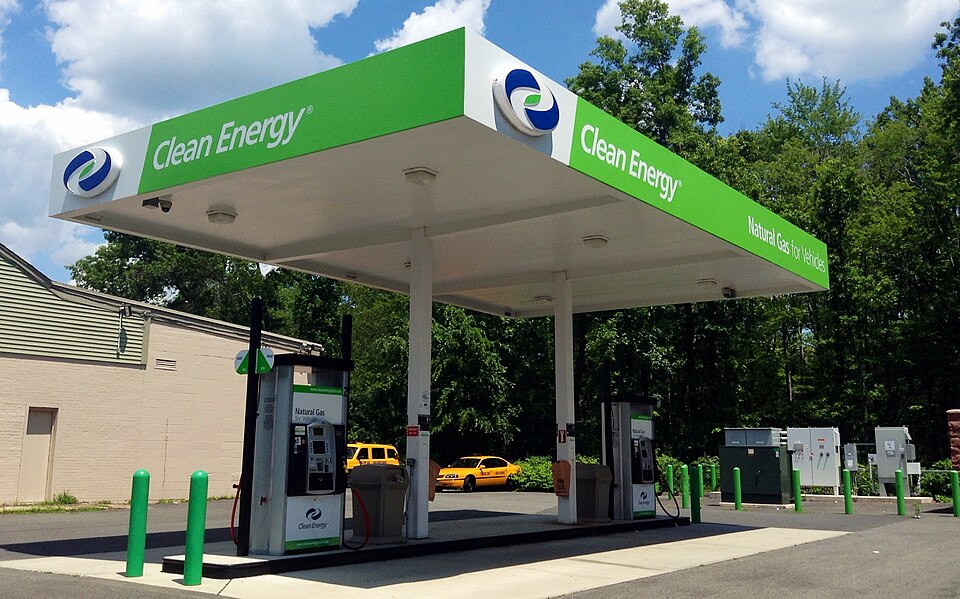
The Myth of “Clean” Natural Gas: How a PR Campaign Fooled Us for 50 Years
Ask a room full of smart, caring people which fossil fuel is the “clean” one, and most hands will go up for natural gas.
It’s easy to see why. You can’t smell it burning. There’s no black smoke. It’s right there in the name — natural.
But here’s something most people don’t know. That squeaky-clean image wasn’t discovered. It was designed–by PR experts and on purpose.
And the industry knew the problems the whole time.
First, What Is “Natural Gas,” Really?
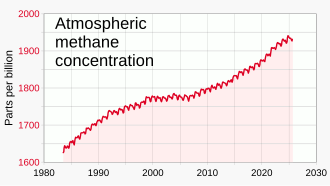
Natural gas is mostly methane — somewhere between 70 and 90%.
Methane is a heat-trapping gas, and a strong one. Over its first 20 years in the air, it warms the planet about 80 times more than the same amount of carbon dioxide.
So why does nobody call it “methane gas”?
Because “natural” sells. In 2020, researchers at the Yale Program on Climate Change Communication tested the names on nearly 2,000 Americans. The term “natural gas” got a 76% favorable rating — far ahead of oil (51%) and coal (39%). When people heard “natural gas,” they thought of words like clean and cooking. When they heard “methane,” they thought of pollution, cows, and global warming.
Same stuff. Different name. Completely different feelings.
It Started With a Catchphrase
The gas industry figured this out a long time ago.
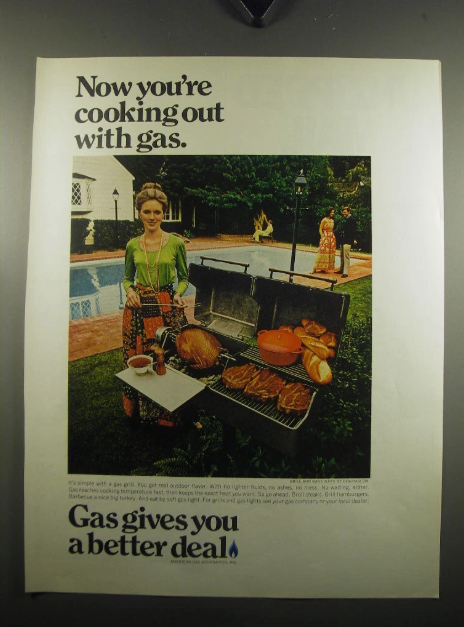
In the 1930s, the American Gas Association — the trade group for gas utilities — was fighting electric stoves for space in America’s kitchens. A gas association PR man named Deke Houlgate came up with the slogan “Now you’re cooking with gas!” and slipped it to Bob Hope’s comedy writers.
It caught on. It showed up in movies and even a Daffy Duck cartoon. Today people say it without a second thought.
That’s the kind of marketing that doesn’t feel like marketing at all.
This is an American Gas Association poster from 1971.
1972: The Year “Clean” Natural Gas Was Born
Around 1970, the industry hit a wall. Its own polling showed many Americans thought gas was a polluting fuel. The first Earth Day had just happened. Environmental laws were moving fast.
So the gas industry did what Big Tobacco had done 20 years earlier. It hired the same PR firms.
In July 2026, the Center for Climate Integrity released a report built on newly uncovered industry documents. It shows that in 1972, ad giant J. Walter Thompson wrote the American Gas Association a new theme: “GAS, CLEAN ENERGY FOR TODAY AND TOMORROW.”
Here’s the kicker. In an internal review that same year, the ad agency admitted it was having trouble selling the “clean” message — because it lacked clear facts to back it up.
In other words, they didn’t have the proof. They ran the slogan anyway.
Here’s the Irony: They Already Knew
The gas industry wasn’t in the dark about methane.
A 1968 report done for the American Petroleum Institute, the oil and gas industry’s biggest trade group, found that oil field operations added methane to the air. It also pointed to leaks from gas pipes in cities.
And in 1972 — the same year the “clean” slogan was born — the American Gas Association wrote a draft report with a section warning about indoor air pollution from gas appliances, like carbon monoxide and nitrogen dioxide (a gas that irritates your lungs). When the final version came out that August, that section was gone.
Borrowing Big Tobacco’s Playbook
When scientists in the 1970s found that gas stoves raised nitrogen dioxide levels inside homes, the industry hired Hill & Knowlton — the very same PR firm that ran Big Tobacco’s “doubt” campaign about cigarettes and cancer.
The plan was familiar. Pay for your own studies. Play up any uncertainty. Make the science look “unsettled.” Boston University environmental health professor Jonathan Levy says these industry-funded studies muddied the waters and stalled federal action on gas stove safety for decades.
Today we know more. A 2022 study estimated that about one in eight cases of childhood asthma in the U.S. is linked to gas stoves.
THE MYThe TH: “Natural Gas Is Clean Energy”
What the Science Says
Let’s be fair first. When you burn gas in a power plant, it gives off about half the carbon dioxide of coal, and far less soot and mercury. That part is real.
But that’s only what comes out of the smokestack. It leaves out everything that leaks before the gas ever gets burned — from wells, pipelines, and storage tanks.
Think of it like trading your old car for one that gets twice the gas mileage. Great deal — unless the new one has a hole in the gas tank.
For decades, the official leak estimate came from a 1996 study done by the EPA and the Gas Research Institute — a research group the gas industry itself created in 1976. That study set the leak rate at just 1.4%.
The real number is much bigger. In 2024, Stanford researcher Evan Sherwin and his team flew planes over U.S. oil and gas fields and took nearly one million measurements. Their study in Nature found that, on average, about 2.95% of the gas was leaking into the air — roughly three times the government’s estimate. In one fast-growing oil region, it was almost 10%.
Why does that matter? Drexel University sociologist Robert Brulle, who studies climate disinformation, explains that once leaks climb past about 3%, switching from coal to gas stops giving you any real climate advantage.
So “clean”? Cleaner than coal at the smokestack, sometimes. Clean? No.
The “Clean” Natural Gas Campaign Never Stopped
The slogans just got a modern makeover.
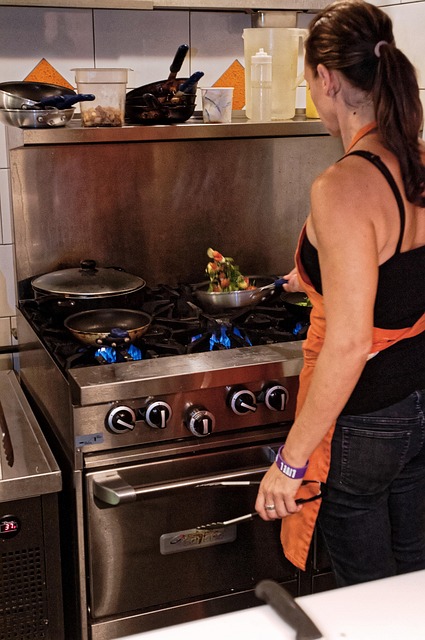
In 2020, Mother Jones reporter Rebecca Leber found that gas trade groups were paying Instagram influencers to post pretty pictures of themselves cooking on gas stoves. One trade group, the American Public Gas Association, planned to spend $300,000 that year on a campaign aimed at young people called “Natural Gas Genius.”
Back in 1988, the industry even made a rap video called “Cookin’ With Gas.” (Trust me, it’s as bad as it sounds.)
And the industry has pushed hard for state laws that block cities from limiting gas hookups in new buildings. More than half of U.S. states now have them.
Why It Matters Now
The “clean gas” story is still being used to build new pipelines, new power plants, and new export terminals. Every one of those is built to run for 40 years or more.
That’s 40 years of leaks. 40 years of pollution. Locked in by a slogan written in 1972.
What Can Actually Help
What you can do:
- Try calling it what it is: methane gas or fossil gas. Words shape how people feel — the gas industry proved that.
- If you cook on a gas stove, run your range hood every time, or crack a window. Your lungs will thank you.
- Try a plug-in induction burner. They’re inexpensive, fast, and you might be surprised how much you like it.
- When your furnace or water heater needs replacing, ask about a heat pump. Check for local rebates first.
- When you see “clean natural gas” in an ad, ask yourself: who paid for this?
Things we can push for together:
- Require honest advertising — no calling a fossil fuel “clean energy.”
- Measure methane leaks with planes and satellites, not industry estimates, and make the data public.
- Ask your state utility commission to stop letting gas companies charge customers for advertising and lobbying.
- Oppose state laws that take away your town’s right to choose cleaner buildings.
For half a century, the gas industry has sold us a feeling instead of a fact. A blue flame, a friendly slogan, and a single word — natural — did the rest.
The flame is real. The “clean” part never was.
Now that we know, we can’t un-know it.
Our kids and grandkids are counting on us!
Want to dig even deeper? Check out my earlier posts, “Trust Me, I’m a Doctor: How Fake Experts Sell Doubt” and “Unmasking CO₂ Myths.”