
What’s Killing Gray Whales? (Hint: It’s Not Wind Energy)
Scientists are sounding the alarm about a gray whale crisis up and down the Pacific Coast. The culprits are well documented — and offshore wind isn’t one of them.
San Francisco Bay is famous for its Golden Gate Bridge, its ferries, and its busy ports. But lately, locals have been noticing something new in those waters: gray whales. Huge, barnacle-covered, and beautiful — they’ve been showing up in growing numbers since 2018. Their arrival has brought both wonder and worry. People line the shores to watch them feed and swim. Researchers race to understand why so many of them are starving. And too often, the whales end up dead.
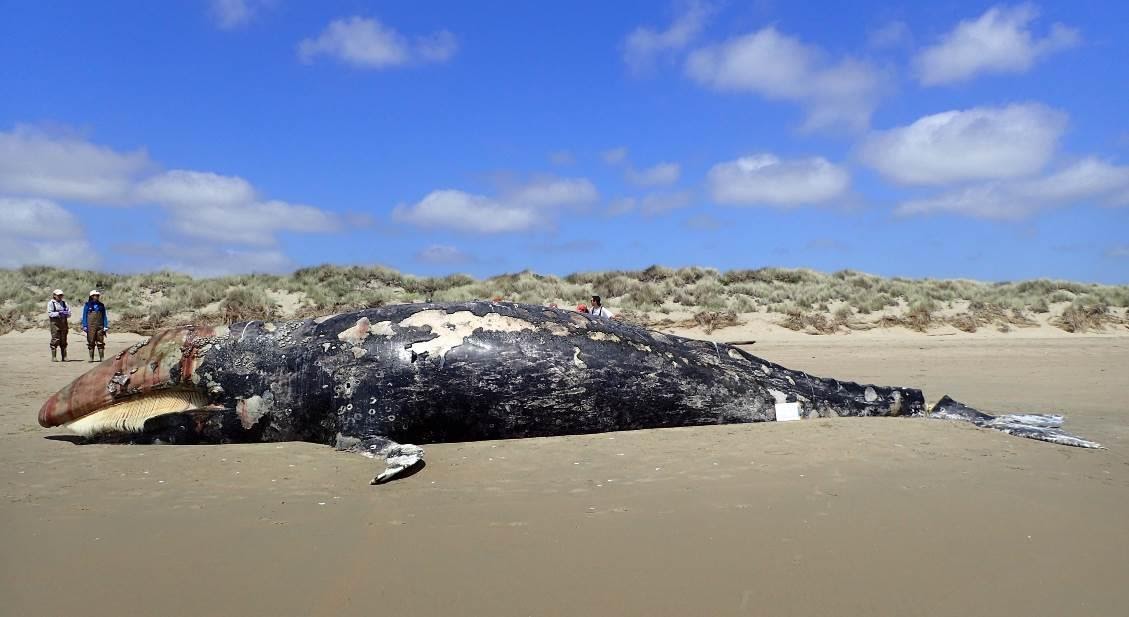
In 2025, crews found a record 21 dead gray whales in the San Francisco Bay area. So far in 2026, at least seven more have died. Dead and dying whales have also turned up in Oregon and Washington state, where researchers say early-season deaths are higher than they’ve ever recorded.
It’s the kind of story that spreads fast online — and so does the misinformation that follows it. Across social media, a familiar claim keeps surfacing: that offshore wind turbines are to blame. Scientists are clear that this is simply not true. Here’s what’s actually going on.
THE MYTH: “Offshore wind turbines are responsible for the spike in whale deaths along the U.S. coastline.”
WHAT THE SCIENCE SAYS: As of 2024, not a single U.S. whale death has been connected to offshore wind turbines. NOAA, the Department of Energy, and a 2025 Government Accountability Office report all found no evidence that wind turbines are killing whales.
A Species That Wasn’t Supposed to Be There

So why are they showing up now? Josephine Slaathaug, a graduate student at Sonoma State University who led a major study on gray whale deaths in the bay, told the BBC: “It’s a new habitat that they’ve chosen to utilise.” The reason, she says, comes down to food — or the lack of it. Gray whales scoop tiny crustaceans off the Arctic seafloor to eat. But as the climate warms and sea ice melts, that food supply is shrinking fast. Many of the whales arriving in San Francisco Bay are adult and juvenile males heading north. They’re visibly thinner than they should be at this time of year. “They don’t have the energy reserves necessary to complete the entire migration back to the Arctic,” Slaathaug explained, “so they may be driven into the bay by hunger.”
“It’s sad to see a dead whale. It’s sadder to see a dead whale that you may have recognised from studying that particular whale. But there’s also a lot that we can learn.”
— Kathi George, researcher who assisted with the study and whale necropsies
Hunger Leads Them to Dangerous Places
San Francisco Bay might look like a good place to find food, but it’s one of the busiest and most dangerous waterways on the West Coast. High-speed ferries, massive cargo ships, fishing boats, and pleasure crafts all share the same water. And slow, starving whales are no match for the traffic.
Slaathaug’s research team studied hundreds of photographs of whales and whale carcasses found in the bay since 2018. They found that nearly one in five gray whales that entered the bay ended up dying there — most after being struck by ships. Of 70 dead whales examined, 30 showed clear signs of vessel collisions. Two of those whales even have names. Denali was spotted near Crissy Field — a popular waterfront park — before being killed by a vessel strike. Ladybug was photographed swimming in the bay and was later found dead. Further north, a young whale swam 20 miles up the Willapa River in Washington state before dying — lost, alone, and starving.
One detail that’s especially worrying: the strandings are starting earlier in the season. In 2026, two whales were found dead in January — when peak numbers usually don’t arrive until April. That shift suggests the whales are in worse shape than ever before.

So Where Does the Wind Turbine Claim Come From?
The rumor linking whale deaths to offshore wind got traction starting around 2023, when whale strandings on the East Coast happened around the same time as surveys for new wind farms. People assumed one caused the other. But scientists investigated and found no connection. Just because two things happen at the same time doesn’t mean one caused the other — scientists call this a false correlation.
Politicians and local groups with ties to fossil fuel and billionaire-funded think tanks push this claim. At the same time, the federal government quietly cut funding for the very whale research programs that could investigate the real causes. Of 30 North Atlantic right whale deaths studied between 2017 and 2024, 25 were caused by ship strikes or entanglement in fishing gear. Zero were linked to wind energy. In Europe, where offshore wind has existed for over 30 years, national agencies have also found no causal link between wind farms and whale deaths.
THE REAL DANGER – Ship collisions are the leading cause of death for large whales worldwide. Climate change is making things worse by forcing hungry whales into busy shipping lanes they never used to travel through.
Whales as a Warning Sign
Researcher Kathi George, who helped with the study and performed necropsies — animal autopsies — on some of the dead whales, put it this way: whales can be “harbingers of bigger changes under the surface of the ocean.” In other words, what’s happening to the whales is a signal. The Arctic is changing, the food chain is shifting, and animals that have survived for millions of years are struggling to adapt fast enough.
John Calambokidis of the Cascadia Research Collective, who has studied gray whales for over 50 years, says what he’s seeing off the Washington coast this year is unlike anything in his career. Scientists say the situation is urgent and getting worse.
What Can Actually Help
One solution scientists point to is slowing ships down. When vessels travel at 10 knots or slower in whale areas, the risk of a deadly collision drops significantly — giving both captains and whales more time to react. NOAA has asked ships near San Francisco and Monterey to voluntarily slow down, but researchers want enforceable rules with real teeth.
The longer-term fix runs through climate policy. The melting Arctic sea ice that’s starving these whales will continue to disappear without serious cuts to the pollution warming the planet. Here’s the irony: offshore wind farms — the very things being falsely blamed for whale deaths — are part of the solution to the fossil fuel pollution causing the crisis in the first place.
Gray whales have been swimming the Pacific for millions of years. They deserve our protection — and that starts with getting the facts right.
More myths. More facts. Follow along.